I want to become a Millionaire…

Last blog post was an article from Trak.in about “India’s Millionaires” and how the number got doubled last year even with all the economical uncertainity. I decided to continue the topic by writing about Millionaire Mindset and evaluating my own goal of becoming High Networth Individual (HNW).

I remember a funny saying, “You can easily get rich in two ways, by birth or by marriage.” First one is obviously not in your hands but second option is feasible if you are confident about your people skills. But if you are a believer of  yourself, there are better ways. Things took a new turn especially during the dot com era and people mentality started dreaming on high places. Thats the same timeframe when “Who wants to be  a Millionaire?” show started airing and creating buzz all about becoming a millionaires. It surely boosted the moral of many individuals to aim big particularly many entreprenuers in the middle class.

Following the hit of the show and dot com era, many millionaires made news more often than ever and millionaires list started growing. According to the “World Wealth Report” which is a report on individuals with a net worth of at least $1 million in all assets except their primary residence. In the World Wealth Report 2007 – “The 11th annual World Wealth Report from Merrill Lynch/Capgemini finds the World’s High Net Worth (HNW) population growing to 9.5 million with their assets rising to $37.2 trillion.

Talk about becoming a Millionaire was everywhere in the internet. Many self made millionaires called themselves as gurus and grabbed the chance to preach their very own mantras via seminars and books. To name a few, Donald Trump, Robert Kiyosoki and more… But recently due to economy crash, investment values plummented and many millionaires dropped from the list.  “The number of U.S. households with a net worth of $1 million or more, not including first homes, fell by 2.5 million to 6.7 million in 2008, according to the Spectrum Group report, as reported by Reuters. As of 2009, there were 2,886,200 HNWI’s in United states. 

Even after seeing the uncertainity of market, job losses and economy struggle, millionaire fire continues to live on among many brave souls. Whether I consider myself as a one among wannabe millionaires or it is just one of my goals, I strongly feel it is a challenging goal to have in your list. It is surely not a easy task for any one especially a guy like me who came from middle class indian family. But it is an achievable target for any hard working individual.

If there is a WILL, there is always a WAY to reach it.  Whether you choose to work hard in your profession, spend less and save more or putting money on different invest vehicles or trying to invent new business ideas or products like iPhone or Joined MLM network, every route has got challenges and worth trying it out.

First thing I did was started tracking my progress by updating networth every month towards my goal to become millionaire in 2015. It really helps me to put things in perspective like where I was, where I am now, know periodic progress and what I need to do move forward in my journey.

Being a hardcore wannabe Millionaire, many times I asked myself number of questions like,

Is the Millionaire goal truely worth it?
Do I have to become a millionaire to live happily?
Why do you need to have Millionaire goal?
Can I have my Financial Freedom when I become Millionaire?
Does only men are up against Million dollar goal?
What is Millionaire Mindset?
Are Millionaires lavish spenders?

Are some things just myths about being a Millionaire or real truth? I plan to dwelve more into these questions in my next post. If you have any questions like above, please share your thoughts and views.
India doubles Millionaires

High Networth Individuals(HNI) or Millionaire lists always grabs my attention any time of the year. Because, I am interested to see who made to the list and get inspired so I can make to the list one day.  

I read the below interesting article from Trak.in about the India’s Millionaires count doubling in the last year. A developing nation where millions of people still live under poverty line but can still produce more HNI every year only proves the point that Rich are getting rich more and Poor are getting more poorer. The gap is widening and there is no solution on the sight to bridge it. I thought may be you guys would be interested, so posting with the persmission from Trak.in editor. Read on…

India Doubles its Millionaires!

It is quite surprising to see the wealth of High Networth Individuals soaring  drastically even though we are just coming out of a global recession. Last couple of years have been tough economically through-out the world – but the wealthier seem to have gone even more wealthier, while the middle class&lower class seem to struggling even more.


According to the World Wealth Report recently released by Capgemini and Merrill Lynch Wealth Management, most countries in the world have increased their HNI (High Net-Worth Individuals) count. While, India has more than doubled it – maximum compared to any other country in the world.


Indian HNI growth (past 5 years)

Year of report India Asia-Pacific World
2005 70,000 2.3 mn 8.3 mn
2006 83,000 2.4 mn 8.7 mn
2007 1,00,015 2.6 mn 9.5 mn
2008 1,23,000 2.8 mn 10.1 mn
2009 84,000 2.4 mn 8.6 mn
2010 1,26,700 3 mn 10 mn
Source: Capgemini, Merrill Lynch Wealth Management

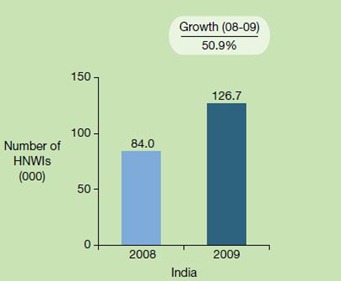
In 08-09, India had 84,000 HNI’s which grew by 50.9% to take to the number to 1,26,700 HNI Indians !


HNI-Growth


In Asia Pacific region, Hong Kong saw the maximum rise with 105% growth in number of HNIs followed by India (50.9%) and China (31%).


I think one of the main reasons for such kind of growth in India is appreciation of stock market in India. The market capitalization increased 103 per cent in 2009, compared to a dip of 64 per cent in 2008.


Here are some of the highlights of the Report


  • The world’s population of high net worth individuals (HNWIs) grew 17.1% to 10.0 million in 2009.
  • The world’s population of high net worth individuals (HNWIs) returned to 10 million in 2009, increasing by 17.1% over 2008.
  • HNWI financial wealth increased 18.9% from 2008 levels to $39 trillion. After losing 24.0% in 2008, Ultra-HNWIs saw wealth rebound 21.5% in 2009.Ultra-HNWIs increased their wealth by 21.5% in 2009.
  • In terms of the total Global HNWI population remains highly concentrated with the U.S, Japan and Germany accounting for 53.5% of the world’s HNWI population, down slightly from 2008.
  • The Asia-Pacific HNWI population rose 25.8% overall to 3.0 million, catching up with Europe for the first time.
  • The Asia-Pacific region was home to eight of the world’s ten fastest-growing HNWI populations, led by Hong Kong (104.4%) and India (50.9%).
  • Asia-Pacific HNWI wealth surged 30.9% to $9.7 trillion, more than erasing 2008 losses and surpassing the $9.5 trillion in wealth held by Europe’s HNWIs in 2009.
  • In India, real GDP growth increased to 6.8% in 2009 from 6.1% in 2008.
  • Market capitalization in India and China almost doubled

Individual Health Insurance & Healthcare Reform Act

Medical insurance is a big part of every American household. It takes about 5-10% of the income if covered by employer or more around 10-25% for self employed individuals. Self Employed individuals including myself are forced to shop for their medical insurance needs in the open individual market. With no proper regulation, they face lot of hazzles to get coverage for themselves and their family.  Without proper medical coverage is a major concern for many individuals.


The hazzle starts with coverage limitation for pre-existing conditions, even rejections in some cases, high premiums, high out of pocket expenses and much more. I myself changed insurers many times in the past 5 years just to keep low deductibles under the budget. With the new National Health Reform Act, we hoped for some relief and looks like some relief is here.


Drawbacks of Current individual insurance market


Let’s first look at some major downsides in getting individual health insurance coverage which might help to appreciate the changes.

  • An individual/self employed cannot buy coverage in the “group market” like small business or corporate companies. Employers usually cannot be turned down for coverage in the group market and also negotiation power.  Instead, the self-employed have to buy coverage in the open individual market which might allow flexibility to choose from different insurers but premium is not bargainable.
  • Also Insurance companies many times rejects applicants with pre-existing conditions and are not required to cover them at anytime. They even cancel the insurance for many individuals when they get sick very badly. So people with serious health conditions was never able to buy coverage in the individual market. Even if they do, they can only get very expensive coverage in the high risk pool, if they can afford it. On top of that, there will be annual or lifetime benefits limitation.
  • Treatment for pre-existing conditions can be excluded for up to 18 months for coverage offered to self-employed people in the individual market. Usually it is only 12 months for the coverage sold to small businesses or corporate in the group market.

Changes on the way by New Health Reform Act


That’s correct. Changes are coming on our way and we can only hope them to be good. Below are some of the proposed regulations, most of them are expected to go active by next year.

  • Insurance companies would no longer be able to deny coverage to kids with pre-existing conditions.
  • Certain annual and all lifetime limits on benefits would be prohibited.
  • Insurance companies would no longer be allowed to drop coverage when policy holders get sick.
  • Prohibits insurers from requiring policyholders to get prior authorization for emergency services.
  • Insurance companies must also spend at least 80 percent of their premium revenue on direct medical care for individual policyholders — or pay rebates, starting next year. 
  • Insurance companies will not be able reject applicants with pre-existing conditions or set premiums based on a person’s health status.
  • Individuals and Self employed people can buy coverage in the Health Insurance Exchange (just like members of Congress), where he/she can choose among competing insurance companies.

As per reports, National health reform act is expected to help around 13.1 million self-employed Americans. At the same time, there are things which still need to considered like Pregnancy coverage. I don’t see any relief for young self employed who want to grow their family. Maternity insurance is another area individual insurance doesn’t cover and hope they do something about it.